How to Tell Real Leather Shoes From Faux Leather
Quick Answer: To tell real leather from faux leather, look at the surface and the cut edges. Real leather has small, uneven pores and slight variation in grain across the shoe. Faux leather usually has a repeated, uniform pattern and a smooth plastic-like sheen. Cut edges are the strongest clue, since real leather shows a fibrous, layered edge while faux leather shows a flat coating. The word genuine on a label means the material is leather, but it doesn’t say which grade.
You find a pair of brown loafers that look like a bargain. The price is fine, the shape is right, and the label says leather. Then you notice the toe has the same pattern repeated across the whole surface, like wallpaper.
One look at the sole edge and the shoe tells you the truth, and you can check that in a shop in under a minute.
How can you tell real leather from faux leather by looking?
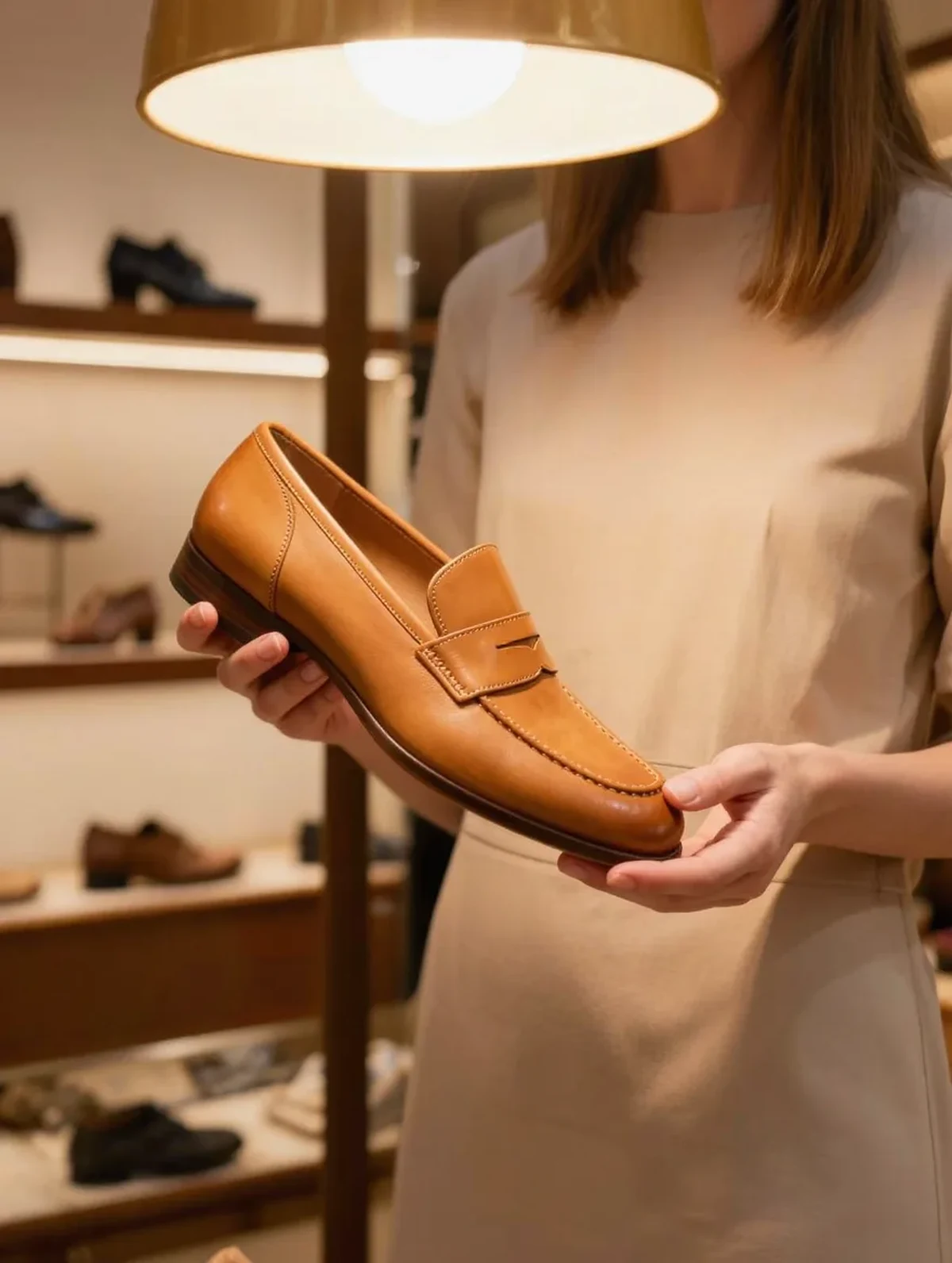
Start with the surface, then move to the edges. Real leather is an animal hide, so it has natural variation. Pores are small and uneven, and the grain changes slightly from the toe to the heel. Faux leather is made to a set pattern, so the same texture repeats evenly across the whole shoe.
The cut edges are harder to fake. Where a piece of leather has been cut, such as the edge of a sole panel or the top of a heel counter, you can often see fibres or fine layers. Faux leather is usually a coating over a backing, so the edge looks flat, smooth or slightly plastic.
Look at the shoe in natural light too. Real leather tends to have a soft, uneven sheen that changes as you turn it. A uniform gloss that stays the same from every angle is a warning sign.
Does a ‘genuine leather’ label mean the shoe is good quality?
It means the material is leather, but not how good it is. Genuine leather is a broad term. It can describe a lower grade made from the split layers of a hide, which often has a surface coating printed with a grain pattern.
Full-grain and top-grain leather are the higher grades. They keep the outer layer of the hide, which is the strongest and shows the most natural texture. Shops don’t always spell this out, so ask the question directly. If the staff can’t tell you what grade the upper is, that’s useful information too.
Bonded leather is different again. It’s made from leftover scraps mixed with a binder and pressed into a sheet. It can look convincing in a shop and tends to peel or crack sooner than solid leather.
Is a higher price a reliable sign of real leather?
Not on its own. Many shoes are sold at high prices with a plain synthetic upper, and some budget shoes use good leather. Price tells you about the brand, the store and the marketing, which can all push a cheap material up the price list.
It’s more useful to check the parts that cost more to make well. Look at the stitching, the lining and the sole join. A leather upper usually pairs with a leather or leather-lined interior, while a shoe that feels cold, sticky or plasticky inside is often synthetic all the way through.
If you’re buying online, read the material line carefully. Look for the upper, lining and sole listed separately. A shoe can have a leather upper and a synthetic lining, and that’s a common mix.

Myth vs Fact: Leather Shoes
Myth: Real leather always smells like leather. Fact: Many leather shoes are tanned and dyed, so the smell can be mild or chemical. A strong odour isn’t proof of quality, and a faux pair can smell of glue or plastic. Smell only tells you a little.
Myth: Real leather always creases in fine lines. Fact: Leather creases where it flexes, and those lines can look fine and irregular. Faux leather can crease too, but the fold often looks sharp, flat or whitened, and it may not soften back.
Myth: A water test settles it. Fact: Real leather absorbs a little water and darkens. Many faux surfaces bead water up. That’s useful, but a water-repellent finish on real leather can also bead water, so don’t rely on it alone.
Myth: Suede means it’s real. Fact: Suede can be real or synthetic. Look at the nap, which should be soft and slightly uneven, and the backing around the edges, which tends to be thinner on synthetic pairs.
What should you check before buying leather shoes in a shop?
Check the inside as well as the outside. Press your thumb into the lining at the heel. Real leather lining feels soft and gives slightly, while synthetic linings often feel thin and slick.
Next, flex the shoe at the ball of the foot. The upper should bend along the natural crease lines, and it shouldn’t crack or show white marks that stay.
Ask three questions: What is the upper made of? What is the lining made of? Is the sole leather or rubber? A good seller can answer all three without hesitating. If the answer changes or stays vague, treat the shoe as synthetic until you know otherwise.
How do you care for leather and faux leather differently?
Leather needs conditioning, faux leather needs a gentle clean. Real leather dries out over time, so a light conditioner once or twice a season keeps it supple. Test any product on a small hidden spot first, because some dyes shift.
Faux leather doesn’t absorb conditioner in the same way. Wipe it with a damp cloth and mild soap, dry it straight away, and avoid heavy polishes that can leave a film. Harsh solvents can strip the coating and leave the surface cloudy.
Both materials hate being left soaked. Dry them at room temperature, away from radiators, and stuff them with paper so they keep their shape.
FAQ: Real Leather Questions, Answered
Can a faux leather shoe look as good as real leather?
Yes, especially in a clean, structured style. Faux leather is often easier to wipe clean and cheaper to replace, which suits some people well. It just won’t soften and age the way solid leather does.
Is genuine leather the same as full-grain leather?
No. Genuine leather is a general term that can cover lower grades. Full-grain is the top layer of the hide and is usually the best quality you’ll find on a mainstream shoe.
What is the quickest way to spot a fake in a shop?
Look at the cut edges and the repeating pattern on the surface. If the edge looks flat and the grain looks identical across the whole shoe, it’s most likely synthetic. This is general information, and no single test is perfect.
TL;DR:
- Real leather has uneven pores and natural variation, while faux leather repeats a set pattern.
- Check the cut edges; real leather looks fibrous and layered, faux leather looks flat and coated.
- ‘Genuine leather’ is a real material, but it can be a low grade, so ask for the upper, lining and sole materials.
- Price and smell don’t prove much on their own, so trust what you can see and feel in the shop.
The next time a pair looks like a bargain, spend a minute on the edges and the lining before you pay. A good shoe will still look good after that check.
Keep Reading
This article is for general styling and informational purposes only. Trends, sizing, availability and pricing may vary by brand and season.