Block Heels Clicking on Hard Floors: Causes and Quick Fixes
Quick Answer: Block heels click on hard floors for three main reasons: the heel tip is worn unevenly, the heel cap has come loose, or the leather sole strikes the floor flat with no grip. Start with the table test. Set the shoe on a flat table and see whether it rocks. If it does, the tip is worn. A rubber heel pad or a sole grip layer fixes most mild cases at home, and a cobbler handles the rest.
The click usually starts on the second or third day you wear the new pair. Every step across the office tile sounds like a small clap, and you can feel people look up. You are not imagining it, and the shoes are not necessarily cheap. The noise almost always has a mechanical cause you can find in about ten minutes.

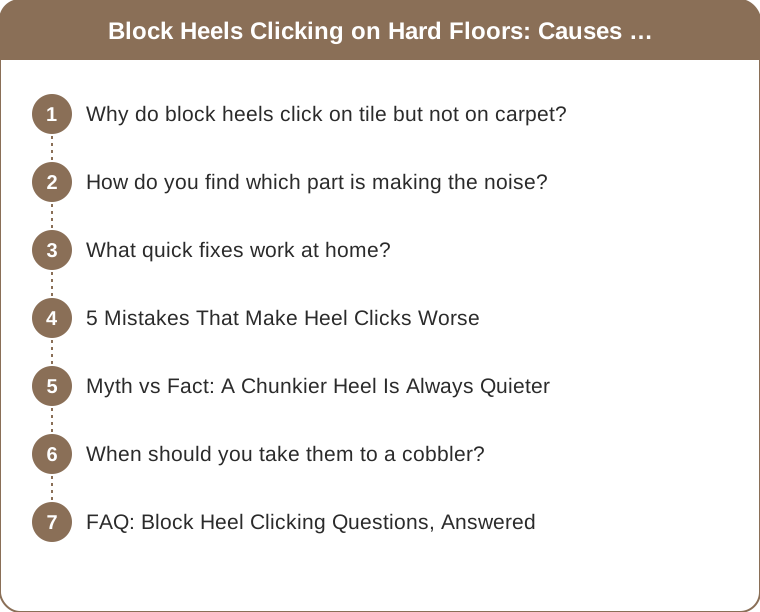
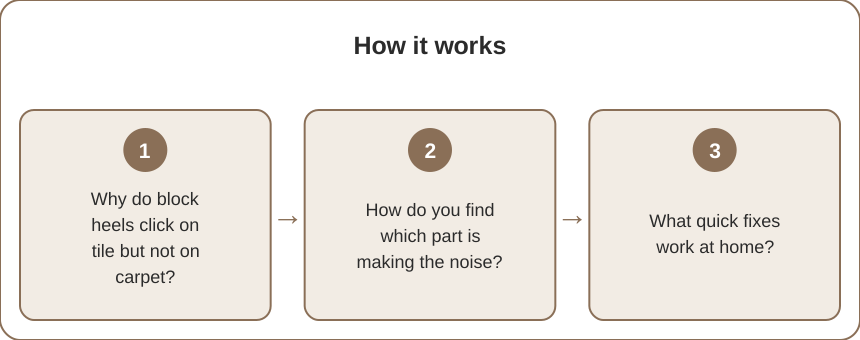
Why do block heels click on tile but not on carpet?
Carpet absorbs the small hit of each step. Tile, marble and polished wood do not. The heel is the first part of the shoe to touch down, so any roughness or gap there becomes audible. A block heel has more contact area than a stiletto, which means the sound is often deeper and carries further.
Three things cause most of the noise. The heel tip wears down at an angle, so only one edge hits the floor. The heel stack has a gap where the layers have separated over time. Or the sole is smooth, hard leather with no grip material, so it slaps flat on each step instead of landing softly.
Start with the cheapest check. Put the shoe on a flat table. If it rocks, or one edge sits higher than the other, the tip is uneven, and that alone can produce a clicking sound on every step.
How do you find which part is making the noise?
Walk the same length of hard floor three times. Once in the shoes as you normally walk. Once with your weight rolled slightly toward the outside edge of the heel. Once with your weight on the balls of your feet. Listen for where the sound changes.
If the click gets louder when you land on the heel edge, it is the tip. If the noise stays the same in all three walks, it is more likely the sole. If you hear a hollow knock, the heel cap has come loose from the heel stack.
Tap the heel with a coin, the same way you would test a melon. A solid heel gives a short, dull tap. A hollow one rings. That ring means there is air under the top layer, and it usually points to failed glue, which means the fix is a repair and not a pad.
What quick fixes work at home?
Rubber heel pads are the fastest fix. Self-adhesive pads cost only a few dollars, cover the worn tip completely and soften the strike. Clean the heel surface with rubbing alcohol first so the adhesive holds. Trim the pad with a craft knife so it sits flush with the heel edge. A pad that overhangs will catch on the floor and wobble, which creates a new noise.
For smooth leather soles, a clear sole grip layer adds friction and deadens the slap. It wears off faster than a pad, so plan to refresh it every few weeks. It also helps on wet floors, which is a bonus you did not ask for.
Do one heel first, then walk for a day before you do the other. A pad adds a few millimetres of height, and if you balance two different heights the shoe will feel off and you will start walking unevenly without noticing.

5 Mistakes That Make Heel Clicks Worse
-
Walking on the heel edge to avoid the noise. This wears the outer edge faster and the click gets louder within a month.
-
Adding a pad to a loose heel cap. The pad holds the cap in place for a few days, then the glue fails underneath and the cap drops.
-
Choosing a thin, hard rubber tip for a polished concrete office. Hard tips click more on very smooth floors, so a softer tip is the better match there.
-
Waiting until the tip is worn through. Once the heel stack shows, the cobbler has to rebuild the heel, which costs far more than a tip.
-
Blaming the shoe for a fit problem. A heel that slides up and down feels loose and clicks because it is not sitting still on your foot. Check the back of the heel fit first.
Myth vs Fact: A Chunkier Heel Is Always Quieter
Myth: a thick block heel is always quieter because it is sturdier. Fact: a thick heel with a hollow core can ring louder than a slim solid one, because the cavity amplifies the sound. The quietest block heel has a solid core and a dense rubber or composite tip.
Before you buy, do the coin tap in the shop. If the heel rings, ask the staff whether it is a hollow construction. Many people assume the bigger heel is the better buy, and then spend the season hearing every step.
When should you take them to a cobbler?
Go to a cobbler when the tip is worn unevenly by more than about 3 mm, which is roughly an eighth of an inch, when the heel cap moves when you press it, or when the click comes from the sole and a grip layer is not enough.
A tip replacement is usually a small fee, far less than the cost of a second pair. Ask for a rubber tip with a firmer edge if your floors are polished concrete, because a softer tip wears out faster there.
Some brands offer heel repairs or replacement parts, so check the brand’s care page before you pay a shop. Keep the receipt and the shoe box, since they help if the repair is still covered.
FAQ: Block Heel Clicking Questions, Answered
Do heel clicks mean the shoes are damaged?
Not always. A click is often just a worn tip or a loose pad. It becomes a sign of real damage when the heel cap moves, the sole cracks or the heel stack starts to separate.
Will a rubber pad change how the shoe fits?
Slightly. A pad adds a few millimetres of height, which can make the shoe feel a touch shorter in the toe. Test it on one heel for a day before doing the second.
Can I stop the click without any repair?
Often, yes. A pad or a sole grip layer solves most mild cases. If the click comes back after both, the problem is probably the heel construction, and a cobbler is the right next step.
TL;DR:
- Heel clicks come from a worn tip, a hollow or loose heel, or a hard sole with no grip.
- The table test shows an uneven tip in seconds.
- A rubber heel pad or sole grip layer stops most of the noise at home.
- A cobbler is worth it for a loose cap or deep uneven wear.
Block heels should be the easy, quiet shoe you reach for all day. A few minutes of checking usually turns a noisy pair back into the one you love.
Keep Reading
This article is for general styling and informational purposes only. Trends, sizing, availability and pricing may vary by brand and season.