Block Heel vs Stiletto: Which One Fits Your Day
Quick Answer: Pick a block heel when you walk more than a few thousand steps a day or stand through long meetings. Pick a stiletto for seated dinners, cocktail events, and photos where height changes the whole line of an outfit. A block heel of 2 to 3 inches with a stable base looks polished with tailoring, while a stiletto works best with slim pants or a sleek midi skirt.
You are dressed for the day, the outfit works, and then you look down and realize the shoe was chosen for the photo, not for the walk. By three in the afternoon your arches ache and the fun has gone out of the look. The heel question is less about trend and more about how your day actually moves.
This is general style guidance. Foot comfort varies a lot from person to person, so trust how a shoe feels when you walk in it.

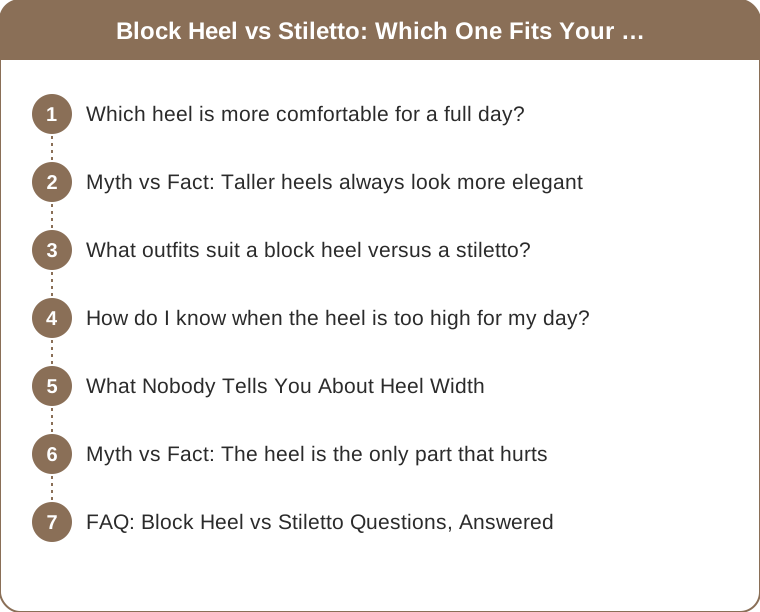
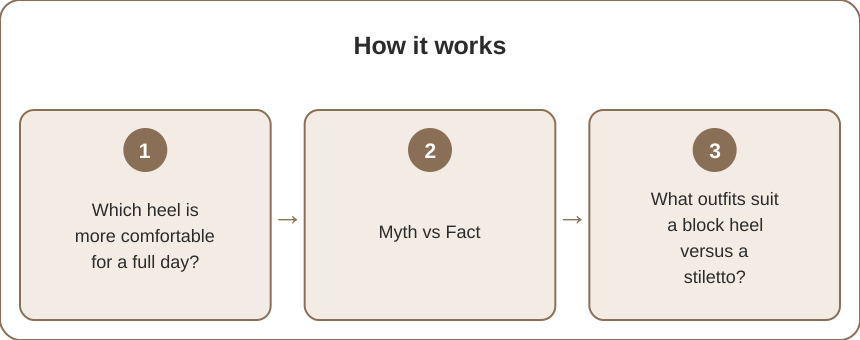
Which heel is more comfortable for a full day?
A block heel spreads your weight across a wider surface, so the pressure under the front of your foot is lower than with a thin stiletto. That matters most on pavement, on stairs, and on hard floors. Look for a base that is at least 1.5 inches wide and a sole that bends a little at the ball of the foot.
A stiletto asks more from your ankles and calves. The narrow point puts most of your load on a small area, and the tilt pushes your weight forward. Many people can wear one for two hours with no trouble, but a full day usually needs a rest break or a switch to flats.
Try a simple test in the store. Walk to the end of the aisle, turn, and walk back. If the heel wobbles or your toes press into the front of the shoe, that pair will punish you by noon.
Myth vs Fact: Taller heels always look more elegant
Myth: Higher is always more elegant. Fact: Height changes your line, but proportion changes your look. A 3 inch block heel with wide-leg trousers can look sharper than a 4 inch stiletto under a short dress that is already doing all the work.
What actually works: match the heel to the hem. A cropped pant shows the shoe and needs a stronger shape, while a full-length pant can hide a lower heel. A slim ankle strap adds leg length without adding much height. Your eye reads the whole outline, so balance the shoe with the rest of the outfit rather than judging it alone.
What outfits suit a block heel versus a stiletto?
Block heels pair well with straight-leg denim, tailored trousers, pleated midi skirts, and oversized blazers. They bring structure and keep a casual look grounded. A stiletto suits slip dresses, satin skirts, cocktail pieces, and anything with a fitted silhouette where a sharp line is the point.
As a rule, the more relaxed the outfit, the more a block heel helps. The more formal the setting, the more a stiletto earns its place. A good shoe edit includes at least one of each, so you can switch without rebuilding the look from scratch.

How do I know when the heel is too high for my day?
Check three signs. Your toes press forward, your calves feel tight by mid-afternoon, or you start walking on the outer edge of your foot. Any one of these means the heel is too high or too narrow for the day ahead.
Plan ahead instead of hoping for the best. Keep a pair of flats in your bag or at the office. Many people pack a slim ballet flat or a loafer and switch once the walking starts. That habit lets you keep the polished look for the photos and still get through a long day without limping home.
What Nobody Tells You About Heel Width
Most shoe shopping focuses on height, but the width of the heel changes how a shoe feels more than almost any other detail. A narrow heel concentrates your weight on a small point, and that point can sink into soft ground, catch in a sidewalk grate, or wobble on a worn tile floor. A wider heel gives you a stable base, even when the height stays the same.
Look at the heel from the side and from behind. If the heel tapers sharply to a thin point, expect it to feel unstable after a few hours. If the heel is a chunky block that stays the same width from top to bottom, you will usually get more steadiness with less effort. A slightly tapered block, around 1.5 to 2 inches at the base, is a good compromise for most people.
Materials matter too. A leather or suede heel bends a little with use and can settle around your foot. A hard plastic heel stays rigid, so it needs a better fit from the start. If you buy a pair with a rigid heel, make sure the back of the shoe holds your heel in place without slipping.
Myth vs Fact: The heel is the only part that hurts
Myth: If a shoe has a low heel, it will always be comfortable. Fact: Toe box shape and footbed support can cause as much pain as a high heel. A pointed toe that squeezes the front of your foot can cause more trouble than a 3 inch block heel with a roomy toe.
What to check: press the insole with your thumb. It should feel supportive and slightly cushioned, not flat. Then check the toe box. Your toes should lie flat with a little room to move, not curl or press against the end. Once the heel and the toe box both pass, the shoe is far more likely to survive a full day.
FAQ: Block Heel vs Stiletto Questions, Answered
Can a stiletto ever be comfortable for a full day?
Rarely. If you must wear one all day, choose a lower height, a cushioned insole, and a fit that holds your heel without gripping your toes. Most people still need a break after several hours.
Are block heels too casual for work?
No. A block heel in leather or suede with a pointed or almond toe looks office-appropriate and pairs well with tailoring.
What height should I start with?
Start at 2 to 3 inches, the range where most people feel steady and still get a lift in their silhouette.
TL;DR:
- Block heels win for long walks, stairs, and standing all day.
- Stilettos win for seated events, dinners, and sleek fitted outfits.
- Match the heel to the hem and to the mood of the outfit.
- Keep flats nearby so the day never ends with sore feet.
Choose the shoe that fits the day you actually have, not the day you imagine. The right heel lets you enjoy the outfit from the first meeting to the last drink.
Keep Reading
This article is for general styling and informational purposes only. Trends, sizing, availability and pricing may vary by brand and season.