The Sock Is the Part of the Shoe Everyone Forgets to Style
Quick Answer: Pick one of two strategies: make the sock disappear by matching it to your trouser or shoe for an unbroken leg line, or make it a deliberate accent with obvious contrast. The mistake is the accidental middle — a random half-visible colour that reads as an oversight. Match weight and formality too, not just colour.
You spend ten minutes deciding between the loafers and the boots.
Then you pull on whatever sock your hand lands on first.
That sock is going to be visible for the entire day, at the exact point where three garments meet — and it’s about to do more work in the outfit than the shoe choice you agonised over.

Why does the sock matter so much?
Because the eye is drawn to transitions.
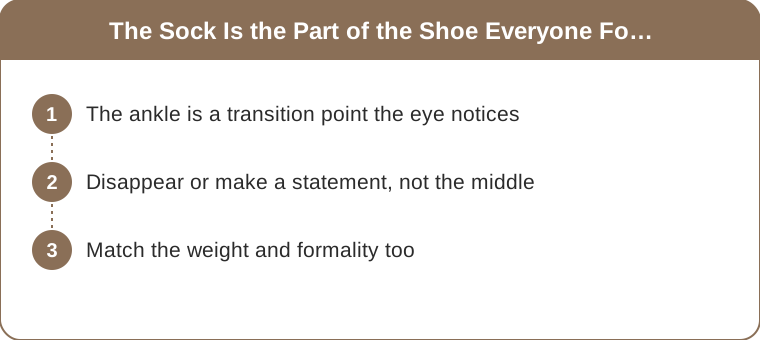
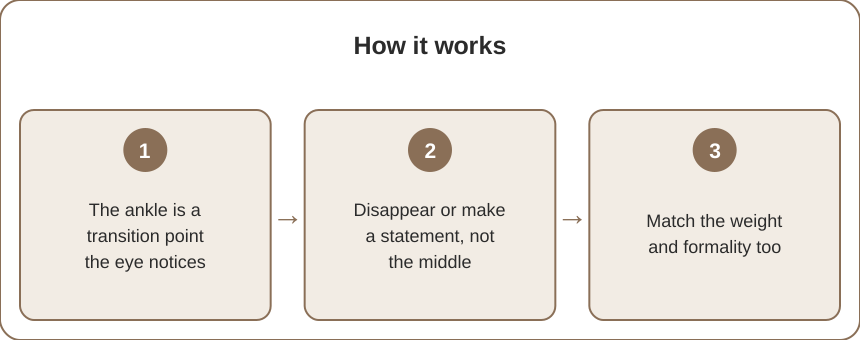
Anywhere one thing meets another in an outfit — waistband, cuff, hem — attention gathers. The ankle is where trouser, sock and shoe all converge, which makes it one of the busiest junctions you own.
And it’s more exposed than it used to be. Cropped trousers, ankle-baring hems and low-cut shoes have put that junction permanently on display. A generation ago it lived under a full-length trouser break; now it’s a visible styling decision whether you treat it as one or not.
Pretending it’s invisible doesn’t remove the decision. It just means you’re making it badly, by default, every morning.

Should socks match your trousers or your shoes?
Either — as long as you commit to one.
Strategy one: disappear. Match the sock closely to your trouser, or to your shoe, creating one unbroken column of colour from knee to toe. This is the elegant default and it visibly lengthens the leg, because there’s no horizontal break to cut the line.
Matching to the trouser elongates more; matching to the shoe grounds the outfit and works well when the shoe is the feature. Navy trousers, navy socks, black loafers: clean. Grey trousers, black socks, black boots: also clean.
Strategy two: make it an accent. A crisp white sock with black loafers. A burgundy sock with tan brogues. A stripe under a cropped trouser. Deliberate contrast reads as confident and deliberate — the key word being deliberate, which usually means repeating that colour somewhere else in the outfit.
The mistake: the accidental middle. A grey-marl sports sock, half-visible, under a navy trouser with a brown boot. Neither matched nor chosen. That’s the one that reads as an oversight, and it’s what most people are doing without realising.
What about sock weight and formality?
Colour is only half of it, and texture mismatch jars even when the colour is right.
- Fine, thin socks → sleek dress shoes and loafers. A chunky ribbed sock peeking out of a delicate flat looks like a mistake because it is one.
- Thick ribbed socks → chunky boots and sneakers. The bulk needs a shoe with enough volume to absorb it.
- Sheer socks → heels. Reads dressy and distinctly modern, and it’s one of the few genuinely fashion-forward moves available at ankle height.
- Cotton sports socks → athletic shoes. That’s their whole job. They’re not a neutral default for every other shoe.
Length matters too. Higher socks look more deliberate than low ones. A crew height with cropped trousers reads as a choice; a no-show that keeps slipping down mid-heel reads as a malfunction — and it’s the single most common ankle problem people don’t notice on themselves.
5 Mistakes Everyone Makes at the Ankle
- The stretched-out sock with a saggy cuff. Elastic dies. A sock that pools at the ankle undoes an otherwise sharp outfit instantly. Replace them more often than feels reasonable.
- Sports socks with everything. The white ribbed athletic sock is not a neutral. It’s a sportswear signal, and it drags a smart outfit sideways.
- No-shows that don’t stay. If they slip, they’re the wrong size or the wrong pair. Buy ones with a silicone heel grip and size down.
- Ignoring the sock when trying on shoes. A thick sock versus a sheer one is easily a half size of fit difference — try shoes in what you’ll actually wear.
- Black socks with everything by default. Black socks with tan or brown shoes creates a hard visual break at the ankle. Match the brown instead.
FAQ
Can you wear socks with sandals?
Yes, and it’s been firmly in fashion for several years now — but it needs commitment. A deliberate contrasting sock with a chunky sandal works; a thin dress sock with a summer sandal reads as an accident.
What sock colour goes with white sneakers?
White for a clean sporty look, or match your trouser to lengthen the leg. Both are strong choices; the weak one is a random third colour that appears nowhere else in the outfit.
How high should socks be with cropped trousers?
Crew height or slightly above works best — the sock reads as an intentional part of the outfit rather than something glimpsed. A visible gap of bare ankle above a low sock is the least flattering of the options.
TL;DR:
- The ankle is a high-visibility junction, and cropped hems made it more so.
- Two good options: disappear (match trouser or shoe) or accent (deliberate contrast).
- Avoid the accidental middle — the random half-visible colour.
- Match weight and formality: fine socks with sleek shoes, ribbed with chunky.
- Higher socks read as deliberate; slipping no-shows read as a malfunction.
Give the sock the same thirty seconds you give the shoe above it. It’s the one styling decision hiding in plain sight — and the one most outfits quietly lose at.
Keep Reading
This article is for general styling and informational purposes only. Trends, sizing, availability and pricing may vary by brand and season.