First Boot Day: Why They Fit in the Shop and Hurt by Thursday
Quick Answer: Boots hurt after a few days for three reasons that are not sizing: you tried them on in the afternoon with the wrong sock, the shaft is fighting your calf rather than the foot, and leather compresses about 4 percent in the first month, so a boot that is perfect on day one is loose by week five. Fit boots in the late afternoon, in the sock you will actually wear, and accept snug across the ball of the foot — but never snug at the heel or toe box.
Every year the same sequence. The boots feel wonderful in the shop, fine on day one, tolerable on day two, and by Thursday you have a blister at the back of the heel and a theory about the brand.
The brand is rarely the problem. Almost every autumn boot failure traces back to a decision made in the fitting room, in conditions that did not resemble how the boot would be worn.
Here is what is actually happening.

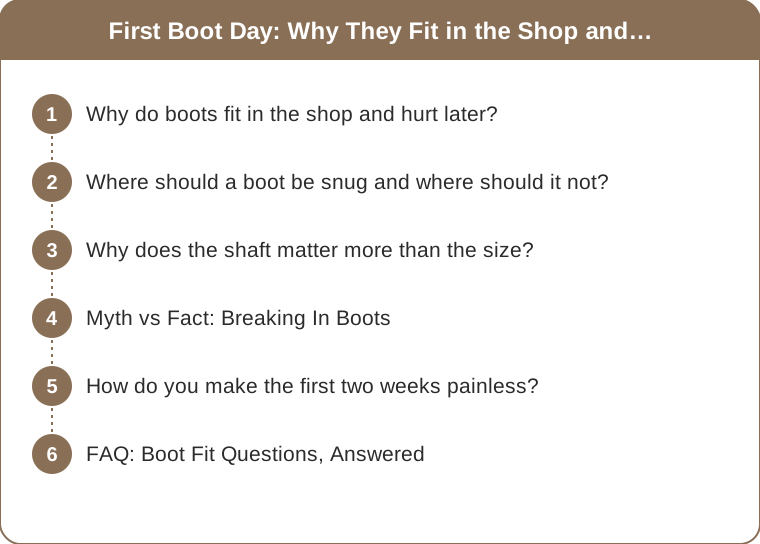
Why do boots fit in the shop and hurt later?
Because feet swell, socks vary, and leather does two opposite things at once.
Feet are measurably larger in the afternoon — commonly by half a size after a day of walking or standing. A boot fitted at 10am on a Saturday is fitted to your smallest foot of the week.
Sock thickness moves the fit by a similar margin. Trying on boots in the thin sock you wore to the shop and then wearing them with a proper autumn sock takes up meaningful room across the instep, which is exactly where boots have no give.
Then there is leather. It stretches across the width as the fibres relax, and it compresses at the footbed as the padding settles. Expect roughly 4 percent of volume loss underfoot over the first month. That is why a boot that is snug across the ball on day one usually ends up right, while a boot that is roomy on day one ends up sliding — and sliding is what causes heel blisters.
Where should a boot be snug and where should it not?
Snug across the ball. Never at the heel, never at the toe.
Across the ball of the foot: firm contact is correct and will ease. This is the only place leather meaningfully stretches, so a boot that is comfortable here on day one will be loose here in a month.
At the heel: you want light contact with minimal lift — around 3 to 5mm of movement when you walk. Zero movement is not the goal; a heel locked completely still usually means pressure that becomes a blister. More than about 8mm and the friction will cause one anyway.
At the toe: about a thumb’s width of space ahead of the longest toe, and enough vertical room that the toes are not touching the upper. Toe box height is the measurement nobody checks and the one that ruins ankle boots for people with slightly higher-volume feet.
At the instep: this is the one you cannot fix. Leather does not stretch upward. If the boot is tight over the top of your foot in the shop, it will be tight forever.
Why does the shaft matter more than the size?
Because most boot returns are calf problems wearing a foot-size label.
Standard knee boot shafts are cut for a calf circumference of roughly 36 to 38cm. Real calf measurements range far wider than that, and no amount of correct foot sizing fixes a shaft that is 2cm too narrow or 4cm too wide.
Measure your calf at the widest point, seated, in the afternoon. Then check the boot’s stated shaft circumference, which good retailers publish and which is worth emailing to ask about when they do not.
Too narrow shows as a hard horizontal indentation and discomfort within an hour. Too wide shows as the shaft collapsing into folds at the ankle, which shortens the leg visually and creates a rub point where the fold sits.
Ankle boots have the same issue in miniature at the shaft opening. A gaping ankle boot opening is the reason so many of them look clumsy — and it is a fit problem, not a style one.

Myth vs Fact: Breaking In Boots
Myth: leather boots need painful breaking in. Fact: they need settling, not suffering. Correctly fitted boots are comfortable from the first hour with mild firmness across the ball. Genuine pain on day one means the fit is wrong, and wearing through it produces a stretched boot and a damaged foot rather than a broken-in boot.
Myth: wet the boots and wear them. Fact: water breaks down leather fibres and strips the oils that keep the boot supple. It does stretch them, permanently and unevenly, and shortens the life of the boot considerably. A shoe stretcher or a cobbler with a stretching machine does the same job in a controlled way for very little money.
Myth: thick socks help you break them in. Fact: thick socks stretch the boot to fit a thick sock, which is fine if that is what you will always wear and a problem if it is not. Break boots in wearing the sock you intend to use with them.
Myth: expensive boots do not need breaking in. Fact: better leather is often stiffer initially, because it is thicker and less processed. The advantage of good leather is that it moulds to your foot and stays moulded — not that it starts soft. Cheap boots feel better on day one and worse on day ninety.
How do you make the first two weeks painless?
Short wears, targeted protection, and one visit to a cobbler.
Wear them indoors for two hours on the first two days, with the sock you will use. The footbed compresses and the leather warms and takes your shape without the mileage that causes blisters.
Pre-tape the two failure points rather than waiting for a hot spot: the back of the heel and the outside edge of the little toe. Surgical tape applied before the first wear prevents almost every first-fortnight blister and costs nothing.
Add a rubber half-sole if the boots have leather soles. It costs a modest amount at any cobbler, dramatically improves grip on wet pavement, and extends the life of the sole. Do it before the first wear, not after the sole is worn.
If a specific spot is tight after a week of settling — one pressure point rather than general tightness — a cobbler can stretch that exact area. That is a ten minute job and it is what stretchers are for.
FAQ: Boot Fit Questions, Answered
Should I size up in boots for thick socks?
Half a size, and only if you will wear thick socks most of the time. A full size up creates heel lift, and heel lift causes more blisters than tightness does.
What if one foot is bigger?
Fit the larger foot and use a thin insole or a tongue pad on the smaller side. Almost everyone has a half-size difference; fitting the smaller foot is the classic error.
How do I stop the backs of my heels rubbing?
Check for heel lift first — if the heel is moving more than about 8mm, the fit is the cause and no plaster will fix it. If lift is minimal, tape pre-emptively and use a heel grip to reduce friction while the leather softens.
TL;DR:
- Fit boots in the late afternoon, in the sock you will actually wear.
- Snug across the ball is correct — leather loses about 4 percent of volume in the first month.
- Heel lift of 3 to 5mm is right; zero lift and excessive lift both cause blisters.
- Measure your calf, not just your foot — most knee boot failures are shaft failures.
- Two hours indoors, tape before the first wear, and a rubber half-sole before the first wet day.
Boots that hurt are almost always boots that were fitted honestly to the wrong version of your foot.
Keep Reading
This article is for general styling and informational purposes only. Trends, sizing, availability and pricing may vary by brand and season.