The Six Weeks When Sandals Are Too Cold and Boots Are Too Warm
Quick Answer: The autumn shoe gap is real: sandals stop working around sixty degrees and boots start overheating above about sixty-five, leaving a band of six to eight weeks with no obvious answer. Loafers, low ankle boots in unlined leather, and a substantial closed-toe flat cover it. The variable that actually decides comfort is not the shoe — it is whether you can wear a sock in it, and that is a fit question you can check before buying.
It is sixty-two degrees. Sandals feel wrong, boots feel like a costume, and sneakers feel like giving up.
This is the most reliable annual gap in a shoe wardrobe, and it lasts about as long as the weather takes to make up its mind.

Why is this gap so hard to fill?
Because it is a sock problem disguised as a shoe problem.
Below about sixty-five degrees, most people want something on their feet. Above about sixty, most people do not want a lined boot. The window where you need a closed shoe that takes a sock but does not insulate is narrow, and most shoes fail at one end or the other.
Summer shoes are cut for bare feet. A sandal or a ballet flat sized to your bare foot will not close over a sock, and adding one changes the fit by a quarter to a half size. This is why the obvious solution — just wear socks with your flats — usually feels tight and looks wrong.
Winter boots are lined and often shearling-backed. They are built to hold heat, and at sixty-five degrees they hold it very effectively. Sweaty feet at lunchtime is not a styling failure, it is a construction one.
And the visual problem sits alongside the practical one. A heavy winter boot with a light late-summer outfit reads as two seasons at once, which is the specific look everyone is trying to avoid in this stretch.
So the requirement is precise: closed, unlined or lightly lined, roomy enough for a thin sock, and visually light enough for warm-weather clothes.
Which three styles actually cover it?
A loafer, an unlined low ankle boot, and a substantial closed-toe flat.
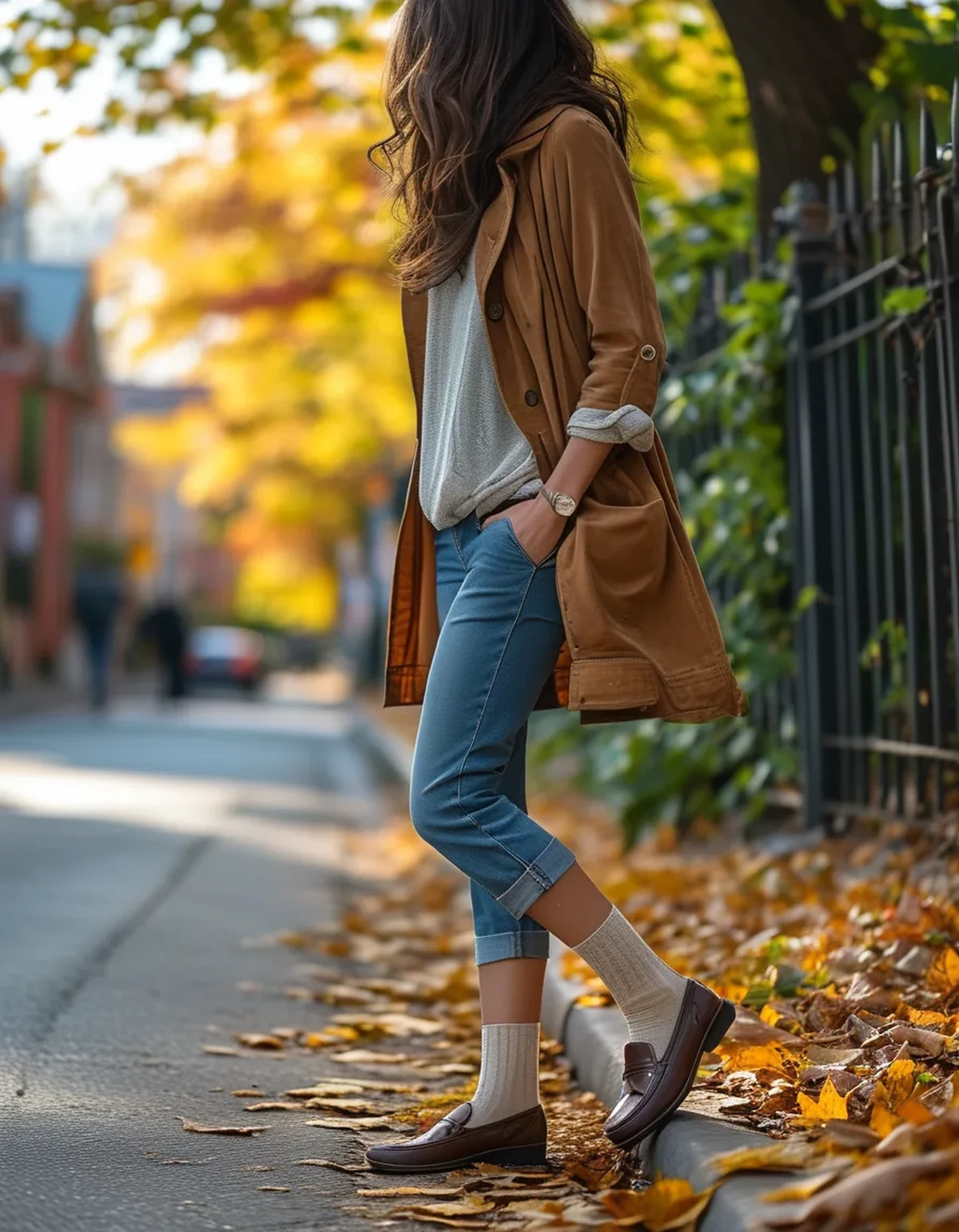
The loafer is the strongest single answer. It is closed, unlined, structurally light, and it looks correct with everything from cropped trousers to a midi dress. Buy it half a size up from your sandal size so a thin sock or a no-show fits without pressure. A leather sole is cooler than rubber; a chunky rubber sole extends it further into cold weather.
The unlined low ankle boot handles the cold end of the band. Unlined is the whole specification — the same silhouette with a lining is a winter boot. Keep the shaft low, at or just above the ankle bone, so it reads light rather than heavy, and choose a slim profile over a chunky lug sole for warm-weather outfits.
The substantial closed-toe flat covers the warm end. A Mary Jane, a closed-toe mule, or a structured ballet flat with a real sole — not a thin soft one, which reads as summer. The sole thickness is what makes it season-appropriate, more than the color or the material.
Between them, these three cover roughly forty to fifty degrees of range, which is more than any winter or summer shoe manages.
And what to skip: a lightweight sneaker. It works and it is the default for a reason, but it is the piece most likely to make a considered outfit read as unfinished. Fine for errands, weak for anything else.
Myth vs Fact: Transitional Footwear
Myth: You cannot wear sandals after Labor Day. Fact: There is no date, only temperature and material. A closed-back sandal or a leather slide in a warm week in October is entirely correct — it is the flimsy summer sandal in a cold week that reads wrong.
Myth: Socks with loafers is a fashion risk. Fact: It has been standard for years and it is the single most useful transitional move available. The risk is the sock, not the pairing — a sheer or fine-ribbed sock in a color pulled from the outfit reads deliberate; a thick athletic sock does not.
Myth: Ankle boots shorten your leg. Fact: Only when there is a color break between the boot and what is above it. Match the boot tone to your trouser or your tights and the line is unbroken, regardless of shaft height.
Myth: You need a waterproof shoe for autumn. Fact: You need one waterproof pair, not a whole waterproof wardrobe. Most autumn days are dry, and building a shoe rack around the wet ones costs you every other day.
Myth: Chunky soles are only for winter. Fact: A chunky sole is a warmth-neutral visual signal. It adds seasonal weight to the look without adding a degree of actual heat, which is exactly what this band needs.
How do I get the fit right for sock weather?
Buy for the sock you will actually wear, and check the three places shoes fail.
Bring the sock to the fitting. A thin merino or fine cotton sock changes fit by a quarter to a half size, and trying on barefoot in September is how you end up with a shoe you cannot wear in October. This is the single most useful shopping habit in this category.
Check the toe box width first. A sock adds width before it adds length, so the pinch shows across the toes rather than at the end. If it is tight across with a thin sock, it will be unwearable with a real one.
Then check the instep. On loafers and Mary Janes, the instep is where a sock’s thickness has nowhere to go, and pressure there causes the specific ache people mistake for a break-in problem. It is not a break-in problem — instep pressure does not resolve.
And check heel slip with the sock on, not without. A sock reduces friction, so a shoe that grips your bare heel may slip once socked. A shoe that slips a little will blister on a long day.
A practical trick: keep a pair of no-show socks in your bag for the first two weeks of the season. The temperature is genuinely unpredictable and the ability to add or remove a sock mid-day is worth more than owning another shoe.
And if you buy one thing for this band, buy the loafer. It covers the widest range, works with the most outfits, and it is the piece people are most surprised to find they wear four days a week.
FAQ: Transitional Shoe Questions, Answered
What sock works under a loafer without being visible?
A no-show with a silicone heel grip, or a fine sheer sock if you want it seen. The failure mode is a no-show that slides down inside the shoe, and the grip is what prevents it.
Can I wear ankle boots with a midi dress in warm weather?
Yes, provided the boot is unlined and slim. The issue in warm weather is heat, not proportion — a lightweight boot with a midi is one of the most reliable transitional outfits there is.
Are mules a good transitional shoe?
Closed-toe mules, yes, and they are underrated here. Open-back means airflow, closed-toe means it reads seasonal, which is exactly the combination this band wants.
How do I stop new leather shoes from being cold and stiff?
Wear them indoors with your intended sock for a few evenings first. Leather softens to your foot before it softens to your weather, and doing it at home avoids the blister stage in public.
Should I put my summer sandals away?
Not for another few weeks. Keep two pairs accessible — the closed-back ones — and store the rest. Warm days keep arriving after you have decided the season is over.
TL;DR: The autumn shoe gap is a sock problem, not a style problem.
- Sandals fail below sixty degrees; lined boots overheat above sixty-five. The band in between is six to eight weeks.
- Loafer, unlined low ankle boot, and a substantial closed-toe flat cover the whole range.
- Unlined is the specification that matters on the boot — a lining makes it a winter shoe.
- Buy half a size up from your bare-foot summer size so a sock fits without pressure.
- Check toe box, instep, and heel slip with the sock on, never barefoot.
- Match the boot tone to your trouser and the ankle break disappears.
Try on your loafers with a thin sock tonight. If they pinch across the toes, that is the entire reason autumn feels like it has no shoes in it.
Keep Reading
This article is for general styling and informational purposes only. Trends, sizing, availability and pricing may vary by brand and season.