What to Do When Your Leather Shoes Get Soaked (and What Ruins Them)
Quick Answer: Blot, stuff, and dry slowly at room temperature away from any heat source, then condition once the shoe is fully dry. Water alone rarely ruins leather. What ruins it is fast heat, which drives out the oils that keep the fibres flexible, and drying the shoe out of shape. Give a soaked pair 24 to 48 hours, not one night on a radiator.
Every autumn the same thing happens. You leave in the morning under a flat grey sky, you get caught out somewhere between the station and the office, and by lunchtime you are sitting at a desk with two dark, heavy, unhappy shoes. What you do in the next ninety minutes matters more than anything else you will do to those shoes all year.

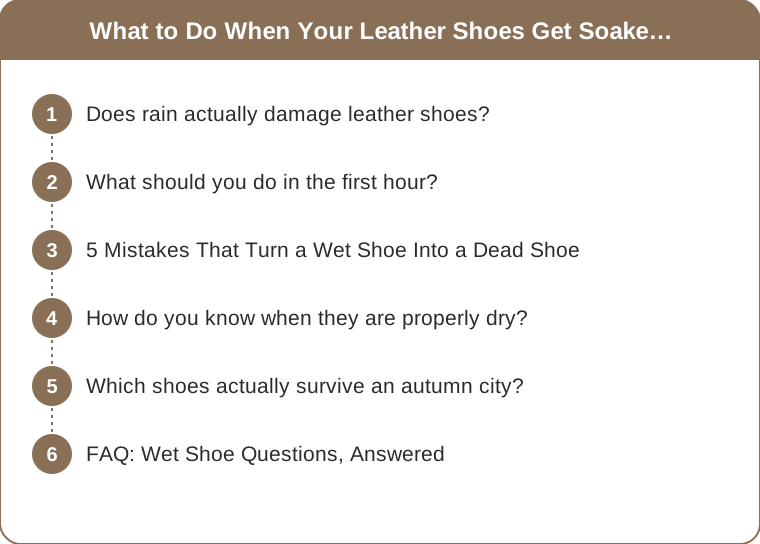
Does rain actually damage leather shoes?
Not by itself. Leather is a hide, and hides have been getting wet for as long as animals have been walking around in weather. What leather does not tolerate is the drying part done badly.
Here is the mechanism. Tanned leather holds a set of oils and fats that sit between the collagen fibres and let them slide past each other. That sliding is what you experience as suppleness. When water floods in, it displaces some of those oils. When the water then evaporates, it carries a portion of them out with it, and the fibres dry closer together and lock. That is the stiffness, the pale chalky patches, and eventually the cracking across the flex point.
Speed makes all of it worse. Slow evaporation at room temperature lets the structure settle gently. Fast evaporation next to a heater shrinks the outer layer while the inside is still wet, which is exactly how you get a shoe that is both hard and warped.
The honest summary: a soaking is a withdrawal from the shoe’s oil account. Your job is to make the withdrawal small and put the money back afterwards.
What should you do in the first hour?
Do these in order, and do them before the shoes go anywhere near a cupboard.
Blot, do not rub. Press a dry towel against the leather and lift. Rubbing pushes grit across a softened surface and dulls the finish.
Take the laces out and pull the insoles. Both hold water against the shoe and both dry faster on their own. If the insole is glued in, leave it and accept the longer timeline.
Stuff the shoe firmly. Plain newsprint or paper towel, packed into the toe first and then the instep, until the shoe holds its own shape. This does two jobs at once: it wicks water out from the inside, and it stops the upper collapsing into a crease that will set as it dries. Change the stuffing after the first hour, when it is properly wet, then every few hours for the rest of the first day.
Set them somewhere with moving air and no heat. A hallway floor is better than a warm cupboard. A fan on low, aimed past the shoes rather than at them, is genuinely useful and costs you nothing.
Then leave them alone. A drenched leather shoe needs 24 to 48 hours. Wearing it damp at hour twelve is how the shape you rescued gets ruined anyway.
5 Mistakes That Turn a Wet Shoe Into a Dead Shoe
1. The radiator. The single most common way people destroy good shoes. Direct heat drives out oil, shrinks the upper unevenly, and can lift the sole adhesive. A hairdryer is the same mistake with more enthusiasm.
2. Conditioning while still damp. Cream on wet leather sits on top of trapped water and seals it in. You get a shoe that looks fed and is quietly staying wet underneath. Wait until it is dry to the touch inside and out.
3. Drying them empty. An unstuffed shoe dries into whatever shape it happens to be in, which after a wet walk is usually a deep crease across the vamp. That crease is permanent.
4. Rubbing off the salt line later. In a few weeks the rain becomes salted slush, and a white tide mark appears. Dry brushing grinds crystals into the grain. Use a cloth barely damp with a 50/50 water and white vinegar mix, wipe once, let dry, then condition.
5. Wearing the same pair the next day. The inside is still holding moisture even when the outside feels fine. A shoe worn wet stretches, and the lining starts to smell in a way that does not come out. This is the actual argument for rotation, and autumn is when it stops being theoretical.

How do you know when they are properly dry?
Not by the outside. The upper feels dry long before the insole and lining do, which is why so many people condition too early and wonder why the leather never quite comes back.
Two checks that work. Press the back of your hand against the inside of the heel; damp lining reads noticeably cooler than dry lining. And pull the stuffing out — if the last change of paper came out with any weight to it at all, you are not finished.
Once they are genuinely dry, condition. Use a small amount of a cream conditioner, worked in with a cloth, then left for twenty minutes and buffed. You are replacing the oils the water took, not polishing, so this step is about penetration rather than shine. Polish afterwards if you want to.
Then, and only then, think about waterproofing. A wax or spray protector applied to a clean, conditioned, dry shoe buys you a real margin next time. Applied to a shoe you just rescued badly, it locks the damage in.
Which shoes actually survive an autumn city?
There is a real difference, and it is mostly about construction rather than price.
Sole attachment matters most. A welted or stitched sole can be resoled and tolerates repeated wettings. A cemented sole — glued — is the one that separates after enough soakings. Look at the edge where the upper meets the sole: visible stitching is a good sign.
Finish matters next. Suede and untreated nubuck are the most vulnerable, though a proper protector spray changes that considerably. Smooth full-grain leather handles rain well. Patent is nearly waterproof but marks and cracks in cold.
And rotation matters more than either. Two pairs alternated will outlast three pairs worn into the ground consecutively, because each one gets a full day to dry out from the inside. In a wet month this is the difference between shoes that last three seasons and shoes that last one.
If you buy one autumn thing this year, make it a second pair you can alternate rather than an upgrade to a single better pair.
FAQ: Wet Shoe Questions, Answered
Can I put wet shoes in front of a fan overnight?
Yes, as long as the air is room temperature and not blowing straight into the shoe at full strength. Moving air speeds evaporation without the heat that causes the damage. Keep them stuffed while the fan runs.
Do rice or silica packets help?
Silica gel packets in the shoe overnight do help a little at the end of the process, once the bulk of the water is gone. Rice does close to nothing for a shoe — the contact area is too small. Neither is a substitute for stuffing and time.
My leather dried stiff and pale. Is it finished?
Usually not. Stiff and chalky is oil loss, which is reversible: condition, wait a day, condition again, and flex the shoe by hand. What is not reversible is a crack that has broken the grain surface. If you can see the crack when the leather is relaxed, that one is permanent and only cosmetic work will hide it.
TL;DR:
- Water rarely kills leather. Fast heat and drying out of shape do.
- First hour: blot, unlace, remove insoles, stuff firmly, and set them somewhere cool with moving air.
- Give a soaked pair 24 to 48 hours and check the lining, not the outside, before you call it dry.
- Condition only when fully dry, then waterproof — never the other way round.
- Two pairs alternated survive a wet autumn far better than one good pair worn every day.
None of this takes real effort, which is the frustrating part: most ruined autumn shoes were ruined by an evening on a radiator rather than by the rain that soaked them. Give them the paper and the two days, and they come back.
Keep Reading
This article is for general styling and informational purposes only. Trends, sizing, availability and pricing may vary by brand and season.