Why Adding Socks Changes Shoe Fit More Than Half a Size
Quick Answer: A standard cotton crew sock adds about 1.5 to 2mm of material around the foot; a thick ribbed or wool sock adds 3 to 4mm. Because that thickness wraps the whole foot, it consumes roughly 6 to 8mm of internal circumference - more than the 6.35mm that separates a half size in most systems. In practical terms, changing from bare feet to thick socks is a full size change in fit, not a half. This is why the boots that fit in the shop pinch on the first genuinely cold morning.
And it explains the autumn ritual of deciding your feet must have grown over the summer.

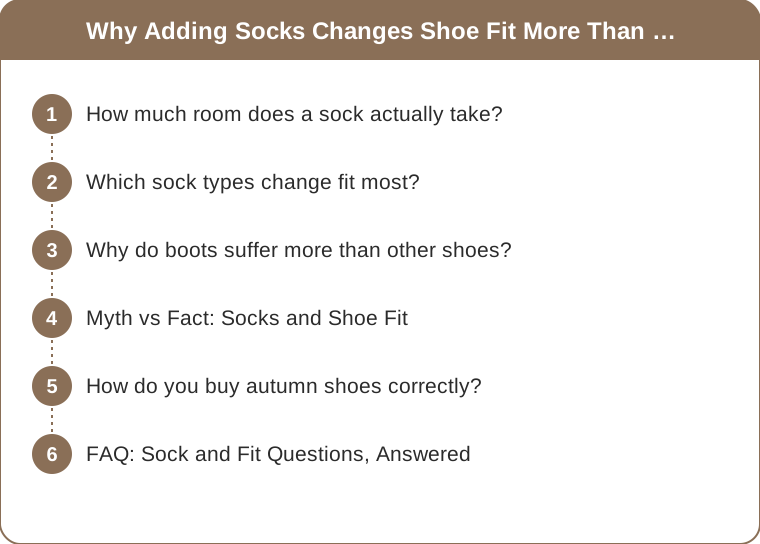
How much room does a sock actually take?
More than the fabric’s thickness suggests, because it surrounds the foot rather than sitting under it.
A sock adds its thickness on both sides of the foot simultaneously. A 2mm sock therefore reduces available width by 4mm and available circumference by around 12mm, and it does the same at the instep, which is where boots are tightest.
For comparison: a half size is about 4.2mm in length in UK sizing and 8.5mm in US, and the corresponding width change is small - typically 2 to 3mm at the ball. A thick sock consumes more room than a half size provides, which is why sizing up half a size and hoping is usually not enough.
There is also compression to consider. A sock does not just occupy space; it compresses under load and rebounds, so it changes how pressure is distributed as well as how much room is left.
Which sock types change fit most?
In rough order of how much room they take:
- Thick wool or boot socks, ribbed - 3 to 4mm. The biggest change, and the ones people buy specifically for cold weather.
- Terry-lined or cushioned athletic socks - 3mm plus, and the cushioning is concentrated under the foot, which also raises your heel in the counter.
- Standard cotton crew - 1.5 to 2mm.
- Fine merino dress socks - around 1mm, and they compress readily.
- Tights - about 0.3mm, negligible for room but slippery, which is a separate problem.
- Bare feet or no-show liners - the baseline most summer shoes were fitted at.
The trap is the jump between the last group and the first. Going from sandals in August to boot socks in October is a change of nearly 4mm of material, and the shoe that has to absorb it is often a boot bought in a warm shop while wearing thin socks.
Why do boots suffer more than other shoes?
Because a boot is closed on all sides and the instep is the constraint.
An open shoe can expand at the throat. A pump can spread slightly at the topline. A boot with a fixed shaft and a zip cannot do either - the volume is what it is, and adding a sock inside means something has to give, which is your foot.
The instep is where this bites first. It is the highest point of the foot and typically the tightest part of any boot, so a few millimetres of sock there produces pressure across the top of the foot rather than at the toes. People report boots as too small when the actual problem is a lack of instep volume, and going up a size adds length they did not need while barely helping.
Ankle boots with elastic gussets and boots with a full-length zip cope far better, because both provide somewhere for the volume to go.

Myth vs Fact: Socks and Shoe Fit
Myth: Buy shoes in the afternoon and you have solved fit. Fact: That handles daily foot swelling, which is real - feet expand measurably through the day. It does nothing about sock thickness, which is a larger variable in autumn than swelling is. Do both: afternoon, and in the socks you will actually wear.
Myth: Thick socks make shoes warmer. Fact: Only if there is room for them. A thick sock compressed into a tight boot loses its loft, and loft is what insulates. A compressed thick sock is colder than a thin sock with air space around it, which is why over-tight boots leave people with cold feet in the same conditions that a roomier pair handles fine.
Myth: Leather will stretch to accommodate the sock. Fact: Leather stretches across the width at the ball, slowly, and barely at the instep or in length. If a boot is tight over the instep in thick socks, it will still be tight in March.
Myth: Half a size up covers winter socks. Fact: Half a size is mostly length, and the sock problem is mostly volume. A wider fitting in the same length usually solves what a longer shoe does not - and if a brand offers width options, that is the better lever.
How do you buy autumn shoes correctly?
Five things, in order of how much difference they make.
Take the socks with you. The actual pair you intend to wear, not an approximation. This is the whole answer and it takes no effort.
Test the instep, not the toes. Do the boot up fully and press a thumb across the top of your foot. If you cannot feel any give at all, the volume is wrong, whatever the length says.
Stand and walk on a hard floor, not carpet. Shop carpet hides heel slip and disguises how a sole flexes. Find the tiled patch by the door.
Check heel lift with socks on. Socks are slippery in a way bare skin is not, so a boot that gripped your heel barefoot can slide with a fine sock. A little lift is normal in a new boot; more than about a centimetre is not.
Look for adjustability. Laces, a zip that runs the full shaft, or an elastic gusset all let one boot handle both a thin sock in September and a thick one in January. A pull-on boot with a fixed shaft handles exactly one sock thickness well.
FAQ: Sock and Fit Questions, Answered
Should I own two boot sizes for different socks?
For most people, no - it is easier to buy for the thicker sock and use an insole or a thicker liner when wearing thin ones. An insole takes up about 2 to 3mm, which conveniently offsets roughly one sock’s worth of thickness.
Can a cobbler create room for thicker socks?
Width and the ball area, yes - a stretcher with a spot plug works well on leather. Instep volume, only slightly. If the pressure is across the top of your foot, stretching will help less than you hope, and that is worth knowing before paying for it.
Why do my feet feel colder in my thickest socks?
Almost certainly compression. Those socks insulate by trapping air in their loft, and squeezing them into a tight boot removes the air. Tight footwear also restricts circulation. A medium sock in a boot with room will outperform a thick sock in a boot without it, every time.
TL;DR:
- A sock wraps the whole foot, so 2mm of fabric removes 4mm of width and around 12mm of circumference - more than a half size provides.
- Boots suffer most because the instep is a fixed volume with nowhere to expand.
- Compressed thick socks insulate worse than thin socks with air space, so tight boots make feet colder, not warmer.
- Shop with your real socks, test the instep rather than the toes, and prefer laces, zips or gussets for adjustability.
The seasonal shoe transition gets blamed on feet, on brands, and on sizing charts. It is almost always a few millimetres of wool that nobody accounted for.
Keep Reading
This article is for general styling and informational purposes only. Trends, sizing, availability and pricing may vary by brand and season.