Why Ankle Boots Rub Your Ankle Bone (and How to Stop It)
Quick Answer: Ankle boots rub the ankle bone when the top edge or a seam of the shaft lands right on the bone instead of above or below it. It’s a question of shaft height and stiffness, so a different size rarely helps. A slightly taller sock, a heel lift of 3 to 5 millimetres to raise your foot, or softening the collar will fix most pairs. If the edge sits dead centre on the bone and the leather is rigid, that pair may simply not match your ankle.
The boots felt fine in the shop. You walked a lap, looked in the mirror and paid. Then you wore them for a real day, and by mid-afternoon one small spot on the outside of your ankle was all you could think about.
It’s a tiny patch of skin over bone with almost no padding. And the cause is usually a few millimetres of leather sitting in the wrong place.

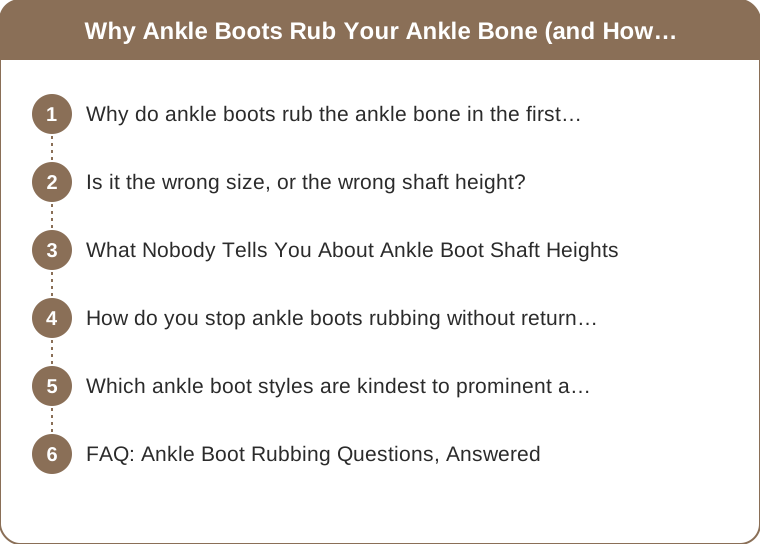
Why do ankle boots rub the ankle bone in the first place?
Because the ankle bone sticks out, and a stiff edge finds it. The bump on the outside of your ankle has very little cushioning over it. Any firm line that crosses it, such as a topline, a seam, a zip end or a pull-tab stitch, presses on the same spot with every step.
Walking makes it worse than standing. Your ankle flexes forward and back roughly once per step, so the shaft slides up and down over the bone thousands of times in a day. That’s why a boot can pass a two-minute shop test and still fail a commute.
The outer bone also sits a little lower and further back than the inner one on most people. A shaft that clears one side neatly can land squarely on the other.
Is it the wrong size, or the wrong shaft height?
Almost always the shaft, not the size. Here’s a simple check you can do at home in your normal socks.
- Find the edge: stand up and feel where the top of the boot, or the nearest seam, meets your ankle. Is it on the bone, above it, or below it?
- Flex test: bend your knee forward over your toes ten times. If the edge digs in only when you bend, the collar is too stiff. If it presses even standing still, the height is the issue.
- Length check: press the toe. About 1 centimetre of room beyond your longest toe means the size is right.
If the length is right, going up half a size won’t move the shaft. It only gives your foot room to slide, which adds friction at the heel and usually makes the ankle rub worse.
What Nobody Tells You About Ankle Boot Shaft Heights
Shaft height is rarely listed, and it varies a lot between styles. Two boots both sold as ankle boots can differ by several centimetres at the top edge, which is the difference between sitting comfortably above the bone and sawing across it.
The cut of the collar matters as much as the height. A Chelsea boot has soft elastic panels at the sides, right where the bone is, so it tends to be the kindest style. A stiff lace-up or a boot with a side zip can put a hard seam or zip end exactly on the bump.
Unlined leather softens; heavily structured collars often don’t. Many people find a soft collar gives noticeably within the first 5 to 10 wears, while a padded or reinforced one stays much as it was on day one.
And the part that surprises even people who sell boots: your two ankles are not the same. One bone often sits a few millimetres lower, which is why only one boot hurts.

How do you stop ankle boots rubbing without returning them?
Start with the sock. A sock that comes at least 3 centimetres above the top of the boot puts a layer of fabric between the edge and the bone. A medium-weight wool blend works well for autumn. Very thin trouser socks tend to slide down and leave you unprotected by lunchtime.
Raise your foot a little. A heel lift or a thin insole of about 3 to 5 millimetres lifts the ankle bone so the edge lands below it. Check the toe room afterwards, since you’re taking up space inside the boot.
Soften the collar. Work the top edge back and forth in your hands for a few minutes, and apply a little leather conditioner on smooth leather. Short wears of 30 to 60 minutes around the house help more than one long painful day.
Pad the spot, not the skin. A small piece of moleskin or felt stuck inside the boot, over the seam that rubs, lasts longer than a plaster on your ankle.
Which ankle boot styles are kindest to prominent ankle bones?
Look for softness and clearance at the sides.
- Chelsea boots: elastic gussets sit over the bone and stretch with it.
- Sock boots and soft suede styles: the shaft moves with your ankle instead of against it.
- Taller ankle boots: a shaft that ends a few centimetres above the bone has nothing to catch on.
- Lower-cut shoe boots: a topline that dips well below the bone avoids it altogether.
Be more careful with rigid lace-ups, boots with a zip that ends at ankle height, and anything with a thick stitched seam running down the outer side. Always try boots in the afternoon, in the socks you’ll actually wear, and walk at least 20 steps including a few knee bends before you decide.
FAQ: Ankle Boot Rubbing Questions, Answered
Will ankle boots stop rubbing once they’re broken in?
Often, if the collar is soft leather or suede and the edge sits only slightly on the bone. Stiff, reinforced collars change very little. If nothing has improved after about ten short wears, use padding or a heel lift.
Can a cobbler fix boots that rub the ankle bone?
Sometimes. A cobbler can stretch or soften a specific spot on the shaft and add padding inside the collar. Changing the actual height of the shaft is rarely practical, so ask about spot-stretching first.
Should I size up in ankle boots if they rub?
No. Sizing up changes length and width, not where the top edge sits. A looser boot lets your foot move more, which usually means more rubbing at the ankle and the heel.
This is general information, not medical advice. If the skin is broken, swollen or slow to heal, see a pharmacist or a podiatrist.
TL;DR:
- Ankle boots rub when the top edge, a seam or a zip end sits right on the ankle bone.
- It’s a shaft height and stiffness problem, so sizing up doesn’t help.
- Fix it with a sock 3 centimetres taller than the boot, a 3 to 5 millimetre heel lift, a softened collar or padding inside the shaft.
- Chelsea boots, soft suede and shafts that end clearly above or below the bone are the safest styles.
Boot season has only just started, so it’s worth sorting this out now. A few millimetres in the right direction and that one sore spot stops running your day.
Keep Reading
This article is for general styling and informational purposes only. Trends, sizing, availability and pricing may vary by brand and season.