Why Heel Height Changes How Far You Can Comfortably Walk
Quick Answer: Comfort in a heel depends far more on pitch — the angle between your heel and the ball of your foot — than on the height printed on the box. A platform or a thicker sole under the toe reduces pitch, so a seven-centimetre heel on a two-centimetre platform walks like a five. Heel width, where the heel sits under your body, and the security of the shoe on your foot do the rest. A stiletto and a block heel of the same height are genuinely different shoes.
You own two pairs at more or less the same height. One you have worn to a full day of walking without noticing. The other you take off in a taxi. Everyone assumes this is luck, or feet, or the brand. It is mostly geometry, and it is visible on the shoe before you ever put it on.

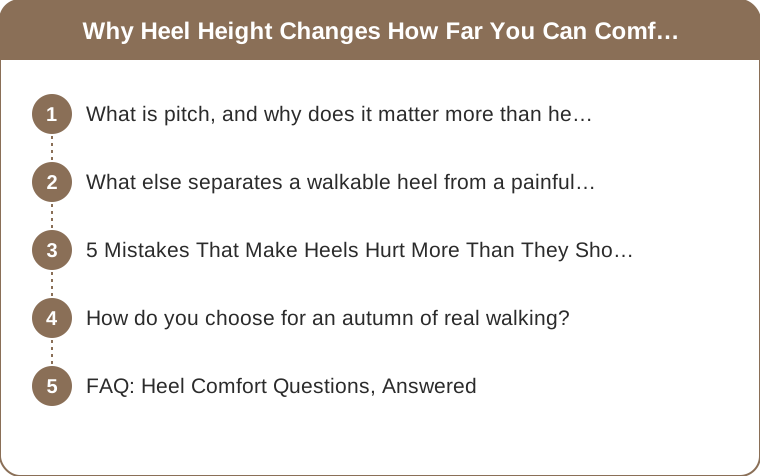
What is pitch, and why does it matter more than height?
Pitch is the drop from your heel to the ball of your foot — the actual angle your foot is held at.
Heel height is measured from the ground, but your foot does not stand on the ground at the toe end; it stands on the sole. So a shoe with a thick sole or a platform under the forefoot raises the front as well as the back, and the angle between them shrinks. That angle is what your calf, your arch and the ball of your foot experience.
The practical consequence is large. A nine-centimetre heel with a three-centimetre platform has the same pitch as a six-centimetre heel with a flat sole, and walks accordingly — which is why platform shoes have always been the trick for wearing extreme height for long stretches.
Pitch decides two things. How much of your weight lands on the ball of your foot, which is the source of the burning ache that arrives around hour three. And how much your calf and Achilles are shortened, which is the tightness you feel the next morning rather than on the night.
So when you are comparing two pairs, do not compare heel heights. Stand them side by side on a flat surface and look at the line from heel to toe. The flatter that line, the further you will walk.
What else separates a walkable heel from a painful one?
Heel width, and therefore stability. A wide block heel gives your body a platform to balance on, so the small stabilising muscles in your foot and ankle do less work per step. A stiletto makes those muscles work constantly, which is fatigue you feel as general tiredness rather than as pain in any one spot. This is why a five-centimetre stiletto can be harder work than a seven-centimetre block.
Where the heel sits. A heel set directly under the back of your heel bone carries weight straight down through the leg. A heel set backward — common on cheaper shoes, where it looks more dramatic — puts you slightly behind your own centre of balance, and you compensate by leaning forward all day.
How securely the shoe is attached to you. This is the most underrated variable. A court shoe is held on by friction alone, so your toes grip to keep it from slipping, all day, invisibly. An ankle strap, a boot shaft or a closed back removes that work entirely, and the same heel height becomes a different experience. If you can only own one pair of heels for real walking, a heeled ankle boot beats every court shoe made.
Sole flexibility at the ball of the foot. A sole that does not bend where your foot bends forces the foot to fight it at every step. Hold the shoe and try to flex it under the toe; some movement is essential, and a completely rigid forefoot is a shoe for standing in rather than walking in.
And toe box shape. A pointed toe that compresses the forefoot narrows the base you balance on and puts pressure on the very joint already carrying extra weight from the pitch.

5 Mistakes That Make Heels Hurt More Than They Should
1. Buying heels in the morning. Feet swell measurably over a day, and a court shoe that fits at ten in the morning can be genuinely tight by six. Late afternoon is the honest time to try shoes on, and it matters more for heels than for flats because there is less room to absorb the difference.
2. Judging comfort standing still in the shop. Standing tests nothing except whether the shoe fits. Walk at least twenty steps on a hard floor, not on showroom carpet, which flatters every shoe ever made. Heel slip and forefoot pressure both only appear in motion.
3. Assuming they will break in. Leather softens and moulds slightly; geometry does not change. A shoe that hurts because of pitch, heel placement or a shallow toe box will hurt identically in a year. Breaking in fixes stiffness, not design.
4. Wearing the same heel height every day. Consistently high heels keep the calf and Achilles shortened, which is what makes flats feel uncomfortable afterward. Varying heights through the week keeps the range of motion, and this is the single most useful habit for anybody who wears heels regularly.
5. Ignoring the sole. A smooth leather sole on a wet autumn pavement turns a comfortable heel into a shoe you walk cautiously in, and walking cautiously is tiring in itself. A thin rubber sole fitted by a cobbler costs little and changes how far you will actually go.
How do you choose for an autumn of real walking?
Start from the ground you will cover. A shoe for a taxi and a restaurant and a shoe for a day in town are different purchases, and trying to buy one pair for both is how most uncomfortable shoes get bought.
For all-day wear, look for a block heel of around four to six centimetres, a slight platform, and a closed back or a strap. That combination — low pitch, wide base, secure fit — is far more forgiving than the height alone suggests, and in ankle boot form it covers most of autumn.
Check the sole for weather before you check anything else. Autumn pavement is wet, leaf-covered and often uneven, and a heel that is comfortable on a dry floor is a different proposition on a wet slope. Tread, even a shallow one, is not a compromise on an elegant shoe.
Try them with the socks or tights you will wear. Tights make a smooth-lined shoe slippery, which reintroduces exactly the toe-gripping problem that a secure fit was supposed to solve. Many people find a shoe that fits beautifully bare-footed slips once tights arrive in October.
And carry the second pair when the day genuinely demands it. This is unglamorous and it is what people who wear heels well actually do. A folding flat in a bag is not a failure of shoe selection; it is the reason the good pair stays enjoyable to wear.
FAQ: Heel Comfort Questions, Answered
Is there a heel height that is objectively fine for everyone?
No, because it depends on your foot length and arch as well as the shoe. As a rough guide, most people find the ball of the foot starts taking noticeably more load somewhere past five centimetres of pitch, but a longer foot handles a given height at a gentler angle than a shorter one. Judge by the flatness of the heel-to-toe line, not by a number.
Do gel pads under the ball of the foot actually work?
They help, modestly, by cushioning and by slightly reducing forward slide. They do not change pitch, so they ease a shoe that is nearly comfortable rather than rescuing one that is not. A pad that makes the shoe tight will cause more trouble than it solves.
Are heels bad for your feet?
Regularly wearing high heels is associated with shortened calf muscles and more pressure on the forefoot, which is an argument for varying heights rather than avoiding them. Persistent pain in the forefoot, the arch or the Achilles is worth having looked at properly. This is general information, not medical advice.
TL;DR:
- Pitch — the heel-to-toe angle — decides comfort, and a platform reduces pitch without reducing height.
- A wide block heel set directly under the heel bone is far less tiring than a narrow one at the same height.
- A closed back or ankle strap stops your toes gripping to hold the shoe on, which is invisible work that adds up all day.
- Try shoes late in the day, walk on a hard floor, and check the sole for wet autumn pavement before anything else.
The pair you can walk in is not the lower pair. It is the one whose geometry is doing the work instead of your feet — and you can spot it standing the shoes side by side on a shop floor, before you ever put them on.
Keep Reading
This article is for general styling and informational purposes only. Trends, sizing, availability and pricing may vary by brand and season.