Why Loafers Gape at the Sides (and the Fix That Is Not Sizing Down)
Quick Answer: Loafers gape at the sides when the shoe has more volume than your foot, usually because you have a low instep or a narrow heel. The length is often correct, so sizing down just crushes your toes. The better fix is to take up volume inside the shoe with a tongue pad or a thin full insole, or to pick a loafer cut with a higher vamp and a snug topline.
You finally found the loafers. They are polished, they look right with cropped trousers, and they feel fine standing in the shop. Then you walk to the car and notice a little gap opening along both sides of your foot with every step, like the shoe is yawning. Before you return them for a half size smaller, stop, because that is the move that ruins more loafers than anything else.

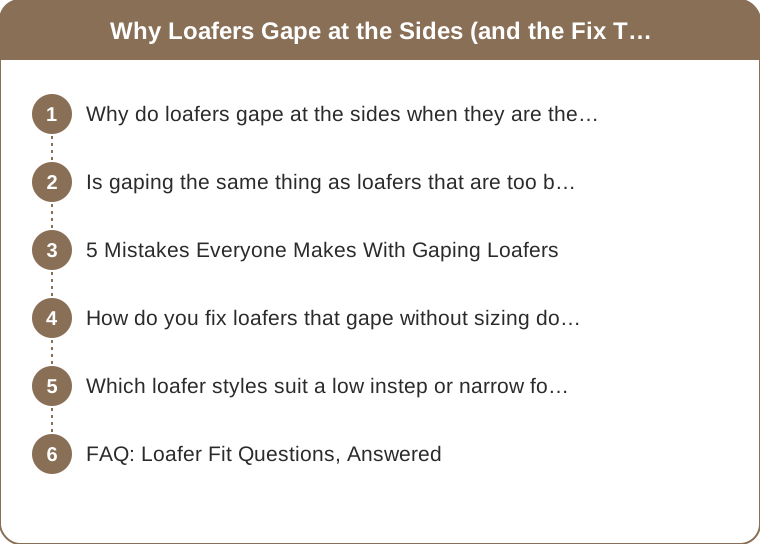
Why do loafers gape at the sides when they are the right length?
Because length and volume are two different measurements, and a loafer has no laces to adjust the second one.
A lace-up shoe lets you pull the sides in over your instep. A loafer is built on a fixed last, so its opening is set in the factory. If your instep — the top arch of the foot — sits lower than the last expects, there is empty space above your foot, and that space shows up as the sides pulling away from you when your foot flexes.
It is especially common in autumn. Many loafers are cut for a slightly higher, average instep, and people with slim or low-volume feet notice it the moment the leather softens after a week of wear.
Is gaping the same thing as loafers that are too big?
Not quite, and the difference decides the fix. Try this quick three-point check in your usual socks.
- Toe room: press the front of the shoe. You want about 1 centimetre, roughly a thumb’s width, beyond your longest toe.
- Heel: walk ten steps. A little lift of 3 to 5 millimetres is normal in new loafers; a heel that pops fully out is not.
- Sides: stand still and look down. If the sides sit flat standing but open when you walk, that is a volume issue.
If the toe room is right and only the sides gape, the shoe is not too long. Going down a size will fix the gap by shoving your toes into the front, and you will pay for it with blisters by lunch.
5 Mistakes Everyone Makes With Gaping Loafers
1. Sizing down. The most common fix and the worst one — it trades a gap for crushed toes and a heel that rubs.
2. Adding a heel grip first. Heel grips help slipping heels, but they push your foot forward and do nothing for the sides.
3. Wearing them sockless on day one. Bare feet are slimmer than feet in socks, so the gap looks worse. Try a thin no-show sock of about 1 to 2 millimetres first.
4. Expecting them to shrink. Leather stretches with wear; it never tightens. A loafer that gapes in the shop will gape more in a month.
5. Ignoring the vamp height. This one surprises even shop staff: a loafer with a longer vamp — the leather covering the top of the foot — holds a low instep far better, and it is the one detail most people never look at.

How do you fix loafers that gape without sizing down?
Start with a tongue pad. It sticks under the top of the loafer, over your instep, and presses your foot gently back into the heel and down into the shoe. Many people find a 3 to 5 millimetre felt or leather pad closes the side gap almost completely.
Next, try a thin full-length insole. A leather or cork insole of about 2 to 3 millimetres raises your foot slightly so it fills the opening. Check the toe room again afterward — you want lift, not pressure.
Ask a cobbler about the topline. Some cobblers can add a thin elastic or tighten the topline binding on unlined styles. It is quick, usually inexpensive, and it keeps the look completely unchanged.
Try the two-fix combo. On very low insteps, a thin insole plus a small tongue pad beats one thick pad, because the lift is spread evenly instead of pressing on one spot.
Which loafer styles suit a low instep or narrow foot?
Look for a higher, longer vamp. Penny loafers and horsebit styles with more leather over the top of the foot hold low-volume feet better than cut-away, low-throat designs.
Choose a snug topline and a softer lining. Unlined suede moulds to the foot and closes up slightly over the first week, while stiff patent keeps its shape and its gap.
Check for a narrow or combination last. Some makers offer a narrower heel than forefoot, which is ideal if your heel is slim but your toes need room. When in doubt, try loafers in the afternoon, when your feet are at their daytime size, and walk at least twenty steps before deciding.
FAQ: Loafer Fit Questions, Answered
Should loafers feel tight when you first buy them?
They should feel snug across the instep and secure at the heel, but never tight at the toes. Leather gives slightly across the top with wear, so a gentle hug is fine; pinching is not.
Will a tongue pad make loafers uncomfortable?
Not if the pad is the right thickness. Start thin and add a second only if the gap remains. If you feel pressure on the top of your foot after an hour, the pad is too thick.
Can I wear gaping loafers with thicker socks instead?
For autumn, a medium-weight sock can fill a small gap nicely. Just check the toe room, because a thick sock can take up the same half size you were trying to avoid losing.
TL;DR:
- Side gaping in loafers is a volume problem, usually from a low instep, not a length problem.
- Sizing down fixes the gap by crushing your toes, so skip it.
- A 3 to 5 millimetre tongue pad or a thin full insole closes most gaps.
- When shopping, choose a longer vamp, a snug topline and a narrower heel.
Get the volume right and your loafers stop yawning at every step — and they will carry you comfortably from the first crisp mornings of October straight through the season.
Keep Reading
This article is for general styling and informational purposes only. Trends, sizing, availability and pricing may vary by brand and season.