Why Shoes Wear Down Unevenly, and What That Pattern Is Telling You
Quick Answer: Shoes wear unevenly because walking is not symmetrical: your foot lands on the outside of the heel, rolls inward, and pushes off through the front, so the outer heel and the inner forefoot take most of the load. Wear on the outer heel edge is normal for almost everybody. What is worth noticing is asymmetry between the left and right shoe, wear that reaches the heel counter, or wear concentrated under the big toe joint — those three patterns predict which pairs will start hurting and which ones are worth resoling.
You pull last season’s boots out, turn them over, and one heel is visibly more worn than the other. The instinct is to assume something is wrong with you. Usually nothing is. But the sole is genuinely a record of several hundred thousand steps, and reading it takes about twenty seconds — which is faster and more useful than most shoe advice.

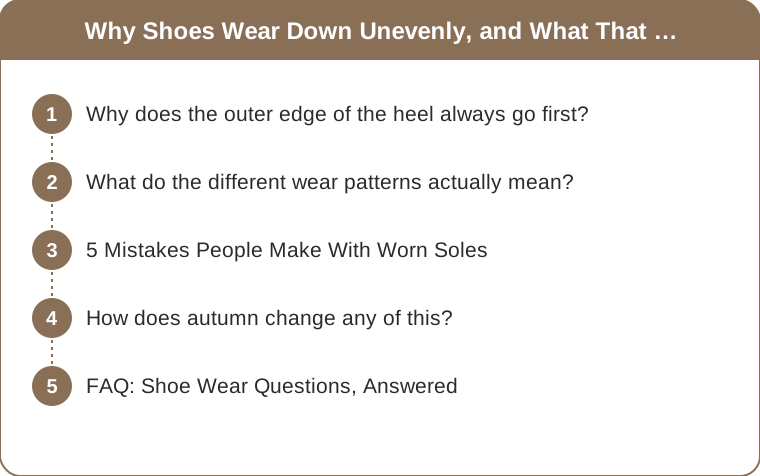
Why does the outer edge of the heel always go first?
Because that is where the foot lands.
A normal walking stride makes contact at the outside rear corner of the heel, then rolls forward and inward across the foot before pushing off near the big toe. That whole sequence is called pronation, and a moderate amount of it is how a healthy foot absorbs shock. The outer heel takes the initial impact of every single step, so it wears first on almost every pair of shoes anybody has ever owned.
So the usual question — is it bad that my heels wear on the outside? — has a dull answer. No. It is the default.
What is worth attention is how far up the wear travels. A worn patch confined to the sole material is ordinary. Once the wear reaches the heel counter — the stiff cup around the back of your heel — the shoe has started tilting you outward with every step, and that tilt travels up through the ankle and knee. That is the point at which a comfortable shoe becomes an uncomfortable one, usually without the owner connecting the two.
And this is why the same pair can feel fine in March and awful in October. Nothing changed about your feet. The platform underneath them tipped.
What do the different wear patterns actually mean?
Turn both shoes over, put them side by side, and look at where the material has thinned.
Outer heel, both shoes, roughly equal. Normal. Resole or replace when the wear approaches the edge of the heel block, and stop thinking about it.
Inner edge of the sole, under the arch or big toe joint. This suggests the foot is rolling inward more than average. Shoes with soft, unstructured soles tend to make it worse, and this is the pattern most associated with arch aching after a long day of walking. A firmer midsole or a supportive insole usually changes the experience noticeably.
Outer edge along the whole sole, not just the heel. The foot is staying on its outside edge rather than rolling in. This foot type absorbs less shock, so cushioning matters more than support — the opposite of the advice usually given to the inward-rolling group, which is why generic shoe advice helps about half the people who read it.
One shoe clearly more worn than the other. Extremely common and usually harmless, because very few people are perfectly symmetrical. Worth mentioning to a physio only if it comes with one-sided pain in the hip, knee or lower back.
Wear under the ball of the foot with a hole starting. Often means the shoe is too long, so the foot slides forward and the flex point of the shoe does not line up with the flex point of your foot. This also produces creasing across the toe box in the wrong place, which is the visible version of the same problem.

5 Mistakes People Make With Worn Soles
1. Waiting until there is a hole. Resoling is straightforward and cheap while the original sole is still mostly there. Once the wear breaks through into the welt or the upper, the repair becomes structural and often costs more than the shoes are worth. The rule of thumb in shoe repair is to go in when you can still see the outline of the original tread at the worn point.
2. Assuming an expensive shoe does not need it. Good leather soles wear faster than cheap rubber ones, not slower. That is a feature — they are meant to be replaced, and the shoe is built to survive several rounds of it. A well-made pair that never gets resoled is simply an expensive pair being thrown away early.
3. Replacing heel tips too late. The small plastic or rubber tip on a heel is a sacrificial part costing very little. When it wears through, the next thing to grind down is the heel structure itself, which is not a cheap repair. The tell is sound: a heel that clicks sharply on pavement has lost its tip.
4. Rotating badly, or not at all. Wearing the same pair on consecutive days concentrates both wear and moisture. Alternating between two pairs more than doubles the life of both, which is one of the rare pieces of shoe advice that is both universally repeated and actually true.
5. Buying the replacement pair in the same size without checking. Feet change over years, and the wear pattern on the old pair is evidence of how the shoe fitted, not just how you walk. Forward-slide wear, in particular, is a sign to try a half size down before repeating the purchase.
How does autumn change any of this?
Wet pavement is the variable nobody accounts for.
A worn sole loses grip long before it looks dangerous. Tread depth that is fine on a dry August pavement becomes genuinely slippery on wet leaves and painted road markings, and the smooth patch on a worn outer heel is exactly where the shoe makes first contact. This is the practical reason to check soles at the start of autumn rather than at the end of winter.
Leather soles and wet weather are a poor combination generally, and a thinned leather sole is worse: it absorbs water, the leather softens, and it then wears several times faster while wet. A thin rubber topy sole fitted by a cobbler solves this permanently and is nearly invisible from the side.
Cold weather also stiffens sole materials, so a shoe that flexed comfortably in summer can feel unexpectedly hard underfoot in October. Combined with thicker socks, which change how the foot sits, this is why an old favourite pair can feel wrong in the first properly cold week — and why the instinct to blame the shoe for deteriorating is usually misplaced.
And storage matters more than anyone assumes. Shoes put away damp at the end of last season dry with the sole slightly distorted, which changes where the next few hundred steps land. Shoe trees and a dry shelf are the cheapest wear-management tools available.
FAQ: Shoe Wear Questions, Answered
How often should I actually look at my soles?
Twice a year is enough for most people — once at the start of autumn and once in spring. Check both shoes together, look at the heel edge and the flex point across the ball of the foot, and note anything that has changed since last time. It takes less than a minute per pair.
Do insoles fix an uneven wear pattern?
They change how the foot sits, which can genuinely reduce discomfort, but they do not change the underlying mechanics of your gait. An over-the-counter insole is a reasonable, low-cost experiment for arch ache. Persistent one-sided pain in the knee or hip is worth a proper assessment rather than a shop-bought fix. This is general information, not medical advice.
Is it worth resoling shoes that were not expensive?
Check whether the sole is stitched or glued. A stitched sole can usually be replaced properly and is worth the cost on any shoe you like. A fully glued construction can often only be patched, which is fine as a one-off but rarely lasts a second time.
TL;DR:
- Wear on the outer heel is normal on nearly every shoe — it is where the foot lands, not a fault.
- What matters is wear that reaches the heel counter, wear under the ball of the foot, or a big difference between left and right.
- Resole while the tread outline is still visible and replace heel tips as soon as they click on pavement; both repairs are cheap before they are not.
- Check soles at the start of autumn, because a worn sole loses grip on wet pavement well before it looks worn out.
The sole is the only part of a shoe that keeps a record of how you actually use it, and it is the part nobody looks at. Turn a pair over this week. Whatever you find, it will tell you more about your next shoe purchase than the fitting-room mirror did.
Keep Reading
This article is for general styling and informational purposes only. Trends, sizing, availability and pricing may vary by brand and season.