Why Tall Boots Slouch at the Ankle (and How to Keep Them Up)
Quick Answer: Tall boots slouch at the ankle for two reasons: the shaft leather is too soft to stand on its own, or the shaft is wider than your calf, so nothing holds it up. Gravity then pushes the extra leather down to the narrowest point, which is your ankle. Store them upright with boot shapers, close the gap at the calf with a thicker sock or a cobbler alteration, and the slouch mostly disappears.
You pull on the tall boots you bought last autumn and they look perfect in the hallway mirror. Three blocks later the shaft has slid down a few centimetres and folded into a soft accordion around your ankle. You tug them up at the crossing. They sink again by the next one. The boots are not broken, and you are not imagining it — the reason is simple, and the third fix below is the one most people never think to ask for.

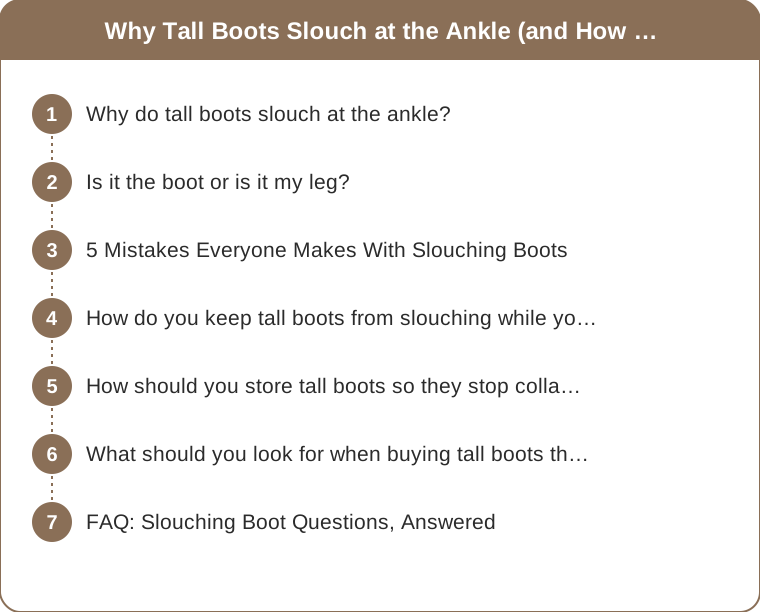
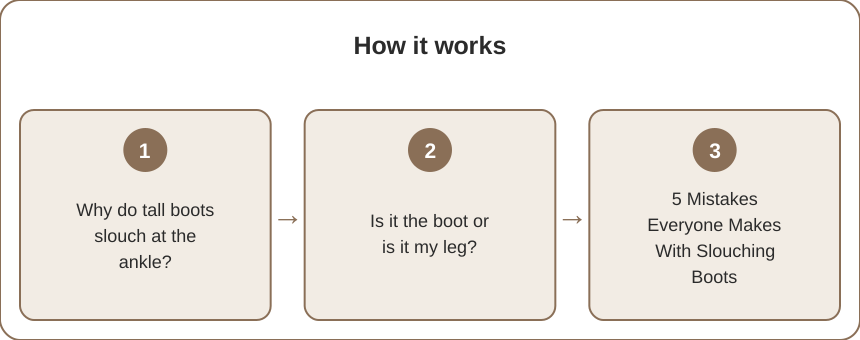
Why do tall boots slouch at the ankle?
Because a boot shaft is a tube, and a tube only stays up if something supports it. That support comes from one of two places: stiffness built into the shaft, or your leg filling it.
Structured riding-style boots usually have a firmer shaft, often with a stiffener at the back seam. Softer fashion boots in thin leather, suede or stretch fabric rely on your calf instead. If your calf is slimmer than the shaft, there is a gap, and the weight of the leather drops into it.
The ankle is where it all ends up for a plain reason: it is the narrowest part of your lower leg and the place the boot bends at every step. Extra material always travels to the flex point, which is why the folds stack up there rather than at the knee.
Is it the boot or is it my leg?
It takes about a minute to find out. Zip the boots on over the socks or tights you would normally wear and stand straight.
- The finger test: slide fingers between the top of the shaft and your calf. One finger of room is a close fit. Two or more fingers means the shaft is wider than your leg, and it will slide.
- The pinch test: take the boot off and pinch the shaft halfway up. If it folds flat with almost no resistance, the leather is too soft to stand by itself.
- The mirror test: look at where the folds sit. A few soft creases at the front of the ankle are normal flexing. A shaft that has visibly dropped below the knee by 3 centimetres or more is slouching.
If the shaft is wide, you fix the gap. If the leather is soft, you fix the structure. Plenty of boots need a little of both.
5 Mistakes Everyone Makes With Slouching Boots
1. Folding them over in the wardrobe. A boot left flopped on its side for six months sets a permanent crease at the ankle. That crease becomes the hinge it collapses on.
2. Buying a smaller foot size to get a narrower shaft. Shaft width does grow with shoe size in most ranges, but your toes pay for it. Fit the foot first, always.
3. Pulling them up by the top edge all day. It stretches the topline, so the shaft gets wider and slides faster.
4. Wearing them over slippery tights only. Smooth nylon gives leather nothing to grip. A knee sock over the tights adds friction and a little bulk at once.
5. Assuming a cobbler cannot help. This is the one that surprises people: many cobblers can take in a boot shaft along the back seam or add a hidden elastic panel, and the result usually looks factory-made.

How do you keep tall boots from slouching while you wear them?
Start with what goes inside. A ribbed knee-high sock, or a boot sock worn over tights, fills a small gap and grips the lining. For a shaft that is only 1 to 2 centimetres too wide, this alone can be enough.
Try boot straps or grip strips. Adhesive silicone strips stuck inside the top of the shaft cling to your sock or skin. Elastic boot straps that sit under the knee do a similar job. Both are inexpensive and reversible, so they are worth trying before any alteration.
Ask a cobbler to take in the shaft. If you can fit two or more fingers in the top, an alteration is the lasting answer. Wear your usual socks to the fitting and ask how much the cobbler can remove without moving the zip. Costs vary a lot by city and by boot, so get a quote first.
Add structure to soft leather. Some cobblers can fit a thin stiffener along the back seam of an unlined boot. It will not turn a slouchy suede boot into a riding boot, but it keeps the shaft from folding in half.
How should you store tall boots so they stop collapsing?
Upright, with something inside the shaft. Purpose-made boot shapers work well, and so does a rolled magazine or a cut length of foam pool noodle. The goal is simply that the leather is never left bent.
Hang them if floor space is tight. Boot hangers with padded clips hold the shaft straight by the top edge. Check the clips are cushioned, because bare metal can mark soft leather over a season.
Condition smooth leather before the cold months. Leather that has dried out creases more sharply and holds those creases. A light coat of conditioner once or twice a season keeps it supple. Skip conditioner on suede and use a suede brush instead.
And give them a day off. Leather absorbs moisture from your leg as you wear it, and damp leather is softer. Alternating pairs gives the shaft roughly 24 hours to dry and firm up again.
What should you look for when buying tall boots that stay up?
Measure your calf before you shop. Wrap a tape around the widest part, standing, over the socks you plan to wear. Many retailers list shaft circumference, and a shaft about 1 to 2 centimetres larger than your calf gives a close fit with room to zip.
Check the back seam. Press along it with your thumb. A firm ridge suggests a stiffener, which helps the shaft stand. No resistance at all means the boot is designed to drape.
Look for adjustment. An elastic gusset beside the zip, a buckle at the top or a lace-up back all let you tune the fit. And decide honestly whether you want a slouch boot — some styles are cut to pool at the ankle on purpose, and no fix will make them stand tall.
FAQ: Slouching Boot Questions, Answered
Do boot shapers really stop boots from slouching?
They stop the storage crease, which is a big part of the problem. They will not fix a shaft that is too wide for your calf, so pair them with a sock, strap or alteration if the gap is the cause.
Can a cobbler make a boot shaft narrower?
Often, yes. Taking in the back seam is a common job on leather boots with a simple shaft. Boots with decorative stitching, a full-length zip at the back or very thick lining are harder, so ask before you assume.
Is it normal for new boots to crease at the ankle?
Yes. Every boot creases where your ankle bends, and a few soft lines at the front are a sign of normal wear. It only counts as slouching when the whole shaft drops and the folds stack up.
TL;DR:
- Tall boots slouch because the shaft is too soft, too wide for your calf, or both.
- Two or more fingers of room at the top means the shaft is too wide to stay up.
- Knee socks, grip strips and boot straps fix small gaps; a cobbler can take in bigger ones.
- Store boots upright with shapers so the ankle never sets into a crease.
Sort out the gap and the storage, and your boots stay where you zipped them — which makes those crisp October walks a lot less about tugging at your knees.
Keep Reading
This article is for general styling and informational purposes only. Trends, sizing, availability and pricing may vary by brand and season.